
4. Making the Marketing Machine Talk to You

Opportunities, Additions & Cuts
By now, we suggest you map out the marketing processes you currently have.
You should take each marketing activity and sales step, putting it into the Marketing Machine model.
What now?
Well now it’s time to start to ask some awkward questions and to get it to ‘talk to you’.
This is where the ideas flow, where you get hit with what we call BFOs (blinding flash of the obvious) and where you get clarity.
There are three ways that your Marketing Machine model will start to ‘talk to you’ once you have it mapped out, or even better, laid out on your boardroom table…
- Helicopter View – by viewing the whole thing (possibly for the first time), in the sequence and order that a prospect and customer will experience your business and its marketing, you’ll quickly spot the gaps and imbalances, and quickly see where the flow is stopped – where conversion is killed, cross sell stifled and referral opportunities missed.
- Putting it Under the Microscope – as you look at every single piece of marketing your business produces – pick it up, scan it, read it, feel it – and immediately assess if it is up to the job.
- Measure and Manage – there are some simple, but crucial numbers that you can run that will open your eyes to the potential for improvement.
So, let’s see what’s it like to experience or to be a victim of your Marketing Machine.
Let’s discover what’s it like to be on the receiving end of your lead generation, your sales process, your prospect nurturing and your customer nurturing.
This powerful process is what enables you to take that helicopter view of your marketing and use that unique viewpoint to discover how to make your marketing great – how to build your high-performance Marketing Machine.
Why should you ‘Walk the Line’
Along the way, you’ll discover three kinds of valuable opportunities…
- What’s working well? What opportunities might you have to get an instant uplift in results by doing more of what already works? What should be significantly increased?
- Where is the wastage? What part of the production line has the highest wastage, what isn’t working? Where can you achieve instant savings and efficiencies by cutting the non-performers? What is it time to let go of?
- And crucially, what’s missing? What are the opportunities to add? What missing elements are stopping your prospects dead in their tracks, what is the big drop off in conversion along the journey, where are valuable prospects falling through the cracks?
Where are hard-won clients being allowed to buy other products and services that you could supply, from other companies? What should be added to join the dots and massively increase the efficiency and effectiveness of your Marketing Machine?
Some of the discoveries you make will be so obvious that you can’t miss them, others you’ll make on your 5th or 6th walk around, others will come from asking awkward questions.
Awkward Questions you Need to Ask
Like a successful factory owner or manager, you’re going to walk the line – looking at the machinery, the equipment, the workstations of your marketing and asking these crucial (but sometimes difficult) questions…
- What’s going on here?
- What are the numbers?
- What does the data tell us?
- What’s the ROI on this?
- Why is this is working so well?
- Why don’t we do more or this?
- Can we 10x this?
- Why do we do it this way?
- Why is this working so badly?
- How do we fix this?
- Can we fix this, or do we drop it?
- What are we missing here?
- How do we plug that hole?
- What should we be doing here?
These are the questions that any good manufacturing business owner will automatically ask as they walk the line. They are a natural by-product of the process.
It’s a level of curiosity, of the need to understand and the need to find great solutions that is a key skill of all great managers.
You don’t have to own a manufacturing business to ‘walk the line’.
We all have a line to walk – it’s the journey our prospects take when they discover and engage with us, and that our clients take as they experience our business.
Accountants, hotels, manufacturers, consultancies, e-commerce, home improvements, cleaning businesses, software companies – we can all map out, lay out and walk the line.
What you’re doing now, is applying a skill that you have, and which is applied to every other part of your business, to your marketing – perhaps for the very first time.
Helicopter View – Strategic
Once you have things mapped out on the Marketing Machine model, you’ll very quickly get the Helicopter view, allowing you to make some rapid and profound observations about your marketing. 
Here are some common ones…
- New Customer Heavy – we have a lot of lead generation and sales process activity, collateral and structure – but almost nothing for unconverted prospects and clients. We’re missing highly profitable opportunities.
- Customer Dependency – we are great at defending, developing and nurturing clients, we put a lot of effort and energy here, but our lead generation and sales are weak. We aren’t winning enough new clients.
- Follow Up Steps – typically we make 2 or 3 follow up attempts, but the optimum number is 5. If we’re not doing at least 5, we’re letting sales slip through our fingers.
- Leads Falling Though the Gaps – when a prospect dithers, delays or we run out of follow up steps, we have nothing in place to stay in touch with slow buyers, to ensure that we’re still in touch when they’re ready to buy.
- Jarring Inconsistencies – when you stand back and look at your marketing emails, webpages, Google Ads, exhibition stands, brochures, quotes/proposals and newsletters – you instantly see that it’s not right. It might be the look, it might be the message, it might be the content, the photos, the case studies – it just isn’t consistent.
Looking at your sales processes in this way will give some immediate and profound observations about what’s wrong, and what you need to do to fix it.
Putting it Under the Microscope
Laying everything out on the boardroom table means that you can look at every single piece of marketing and sales collateral your business produces. You can pick it up, scan it, read it, feel it – and immediately assess if it is up to the job. 
You can put it under the microscope. That may allow you to discover some really important areas of improvement…
- Messaging – your best, most powerful and compelling messages are in your marketing emails – but not on your website, your exhibition stands, or your quotes and proposals. Your marketing collateral isn’t selling hard enough – it has no power, no impact, no cut through.
- Content – your brilliant case studies are buried deep in your website – but they should be in your marketing email communications plan, in your proposals and quotes, and on display on your exhibition stand.
- Endorsement – you know you have some great testimonials and reviews, but you can’t find them anywhere.
- Call to Action – you’re looking at webpages that don’t ask visitors to take any action, you’re reading brochure and flyers without clear, compelling, multiple invitations to respond, you’re holding a copy of a quote with no instructions on how to place an order.
- Inconsistent Look – somehow, your marketing emails, PDF brochures, and sales proposals look like they are from different businesses.
- Testing Deficit – you ask how do we know what’s the best headline, the best offer, the most compelling message, the most effective images, if long copy or short copy works best? And discover that these key performance elements aren’t being tested.
Now you’re starting to live your prospects and customer’s reality – they experience your business through your marketing. You should assess how good your ‘stuff’ is at getting across what your business is about.
Measure and Manage
I really admire the way that people with a finance background can spend 5 or 10 minutes scanning a business’s accounts – their profit and loss, the cashflow forecast and the balance sheet – they do some calculations and then make some profound observations about the business.
I can’t do that, but in much the same way as those accounts talk to an accountant, running some numbers on your marketing and sales processes using the Marketing Machine can really open your eyes and help you to identify some amazing opportunities to improve results and performance.
One of the ways we can look and make it ‘talk’ to us is looking at, for example, the conversion rates.
For this exercise, the first thing I’d like you to do is to jot down what your conversion rate is in your business (do this off the top of your head).
What do you talk about in your office? What’s your conversion rate? Is it twenty percent? One in three, 33%? Less, more? Whatever it is just jot it down now.
Most of us think about a conversion rate in our business. We can fire it off, just like you did just then – it could be 10%, 20%, 30%, 33%. Some people might even say 50%.
Of course, what we’re normally doing is we’re measuring our conversion rate from quote to client. From proposal to sale.
That’s how our sales teams talk to us about their conversion rate. Sales directors, sales managers and salespeople are all measured against each other by conversion rates – from quote or proposal to order.
From Lead to Sale
But from a CEO point of view, from a business point of view, from a Marketing Machine point of view, we can’t afford to do that (or to pay too much attention to it) because our costs, our overheads (direct and indirect) start way back at the lead generation stage. They include the costs of all the steps in the process including the website, going to exhibitions, answering the phones, sending information, printing brochures and much more.
So, we need to look at the conversion and the efficiency rate at each step of our Marketing Machine, from lead to sold, not just quote to sold.
This shift in focus is profound. It allows you to look at the performance of your marketing like never before. It will identify marketing that feels like it is working (but is costing you a fortune) and will identify the areas that may be producing like crazy, but are underexploited.
To understand your true conversion rate, let’s see what happens when we throw a bunch of raw material in one end of your Marketing Machine – follow it through and see what we get out at the other end.
First you need to identify the conversion rate with each step of the process – the progress that prospects make as they travel through your lead generation and sales process.
You can use the boxes below each step of the sales process to put in what you think the conversion rate is on each step…
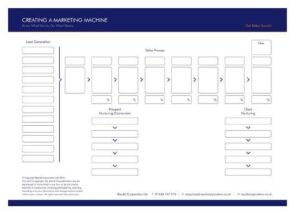
Here is an example of typical conversion rates….
- Box 1: Enquiry
- Box 2: Information Sent – 80% of leads get the information (some go no further than the enquiry)
- Box 3: A follow-up call or email is scheduled and completed. 100% of prospects are followed up
- Box 4: Meeting – 50% of prospects go through to a meeting
- Box 5: Quote or Proposal – 100% of meetings result in a quote being sent
- Box 6: Presentation – 75% get a presentation
- Box 7: Follow up – 100% are followed up
- Box 8: 33% become new clients
Yours may be completely different, you may have fewer (or more) steps, you may have very different percentages – the key is to use your numbers.
In my example, I am assuming that 80% of prospects get information, that 100% of the 80% are followed up. 50% of those eventually go into a meeting. 100% of meeting prospects get a quote. 75% of those go ahead with a presentation. 100% of these are followed up. 33% of those become a new client.
If you’re not completely sure and you can’t easily get the data, just use your best guess. You can always check and redo the numbers later.
Once you’ve got those numbers, what I’d like you to do is throw a batch of raw material (leads) through your Marketing Machine and see what’s working for your business today.
Cold to Sold – Throw a hundred leads into your Marketing Machine
The way we do this is to use the top row and see what happens to 100 leads.
You can start with whatever number you want, but I choose 100 as it is simple for the maths and regardless if your marketing generates 100 leads a month, 100 a day, or 100 a year, it’s usually statistically reliable.
Whatever your start number is, start by putting that number into box 1. Then you just multiply it by the percentages you wrote down earlier as you progress through each stage.
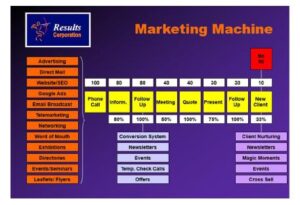
So, if we put 100 leads or enquiries into this Marketing Machine…
We start with 100 on box 1…
- Of the 100, 80% get information, that means 80 for box 2
- 100% are followed up, so we still have 80 for box 3
- 50% have a meeting, so we’ve got 40 meetings in box 4
- 100% of those get a quote or proposal, so we still have 40 in box 5
- At 75% going ahead with a presentation that drops to 30 for box 6
- 100% of those get followed up, with 30 making it to box 7
- 10 become new clients, which is 33% of the 30 that we’re following up.
Can you see what just happened here? By putting some of your numbers (your conversion rate) under the microscope, we’ve made it real – and possibly just induced a case of what I call “conversion rate shock!”.
A business with these numbers may have always assumed that they had a 25% conversion rate because 10 out of the 40 prospects who got a quote or proposal ended up becoming clients.
But in truth, by going right back to the beginning of the line, they have…
… a 10% conversion rate!
Just one in ten becomes a client.
Conversion Rate Shock – Your True Conversion Rates
Now, discovering that your conversion rate might be a lot lower than you thought is no need for you or your team to fall into despair.
If what you thought was 25%, or 33%, or higher, is actually 7% or 8%, or 12% or 10% then should you be depressed or excited?
I think that getting to what is todays reality, despite seeing an apparently lower conversion rate, can be a real moment of opportunity. Can you see where the opportunity is?
Yes, it’s the 90.
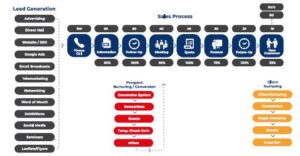
The opportunity is in the 90 that are lost along the way – the 90 out of 100 that today become ‘no’ or ‘no not-yet’?
The 90 are a mixed bag of outcomes. Some of those will be a definite no, maybe because they didn’t credit score properly; this is a good reason that might write off 10 or 15 leads or the 90.
Some of those are no’s because they didn’t like you, and they ejected you out of the process. That’s fine. That might account for another 15.
But we still have 60.
By now some of the 60 have already done business somewhere else. They have now shifted off the horizon for the short-term – and are now medium-term or long-term prospects, depending on the length of contracts or relationships.
But there are normally 20, 30 or 40 left over that are “no, not-yet”.
This is another example of where the Marketing Machine process really comes alive!
This is where the opportunities to significantly improve outcomes start to emerge from the ‘Glob’.
Why does this matter?
Now that we know we have 90 to go for, let’s ‘walk the line’ and see if we can identify some great ways to find 2 out of the 90 ‘no’s’ to bring back to join the 10 clients.
We don’t need a lot of those no’s back to make a real difference.
If we could find a way (or ways) to get two of the 90 back to join the 10, would that be a positive outcome? 
That would mean another 20% more new clients from our Marketing Machine – just by finding 2 out of 90 who can be turned into clients.
You’ll find more examples of where to find the 2 in 90 in the following chapters. But here are a few clues…
- Your sales team follow up each prospect 3 times (on average) – by setting a 5 no’s follow up performance standard, you may well get 1 or 2 additional clients from every 100 leads. Read more about why its worth staying in touch with your prospects here.
- As you walk the line, you pause to read through some recent quotes or proposals. You realise that they are effectively a list of features and prices – no selling! By adding in benefits (whenever you mention a feature), excellent case studies and testimonials, some great images or photos, a confirmation form to sign with a strong call to action – by doing these simple things you could transform the effectiveness of your quote and proposals. Maybe the 2 are there?
- When you look at what happens to prospects that don’t buy, and after the sales team have stopped following up, you realise that they fall into a contactless desert – a great nothingness. What would happen if you started to stay in touch with a constant contact series of email newsletters, new product information, invitations to events and so on? Could another 1 or 2 be retrieved by gently and professionally staying in touch?
As you’ve just seen, ‘Running the Numbers’ is another way that the Marketing Machine model should make your marketing and sales process really start to talk to you.
Unpicking the ‘Glob’, putting what you have into the Marketing Machine model and walking the line gets your marketing to a point where it is understandable, comprehensible and clear – the point where it talks to you and tells you where you need to apply your attention and your focus.
Request Your Website MOT

Join Results Academy™
Become a member of Results Academy™ today for FREE and discover how to create highly effective marketing for your business.
Register now to unlock a wealth of marketing knowledge in our articles, and stay up to date with Results Report directly into your inbox.
Be inspired with idea after idea that you can easily apply to your business to quickly improve sales revenue and boost profits.
Become an Accelerate or Scale member (Coming soon), and gain access to guides, consultations and Results Academy’s AI powered proposal template builder.
Join Results Academy™ today and discover how to make your marketing (and business) really work!